Authority
How I Got a Google Knowledge Panel (And How I Am Making It Permanent)
How Ryan White earned a Google Knowledge Panel, the three moves behind it, and the work of making the panel permanent.
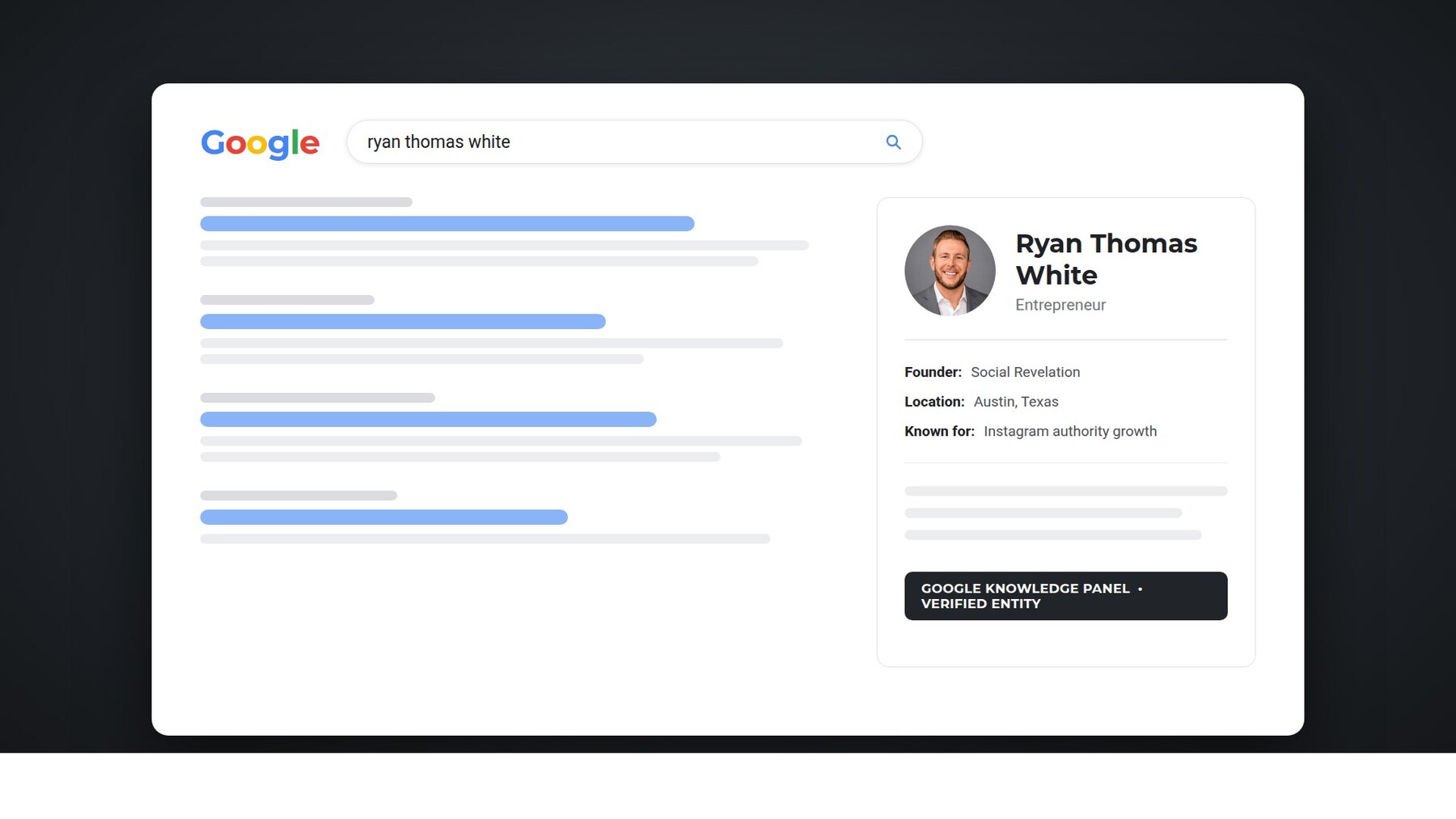
What is a Google Knowledge Panel?
It is the box Google shows for a person it recognizes as a real entity. Not a profile you fill out. A judgment Google makes by cross-checking sources about you.
For anyone who sells trust, it is the strongest credential in search, because it is the one thing on the results page your competitors cannot write about themselves. You can see the result here: my Google Knowledge Panel.
Why did I need one more than most people?
Search my first and last name, and you will find a different Ryan White: the young man from Indiana whose fight with AIDS changed American law. A federal program carries his name. He earned that place in history, and I will never compete with it. I did not need to.
I needed Google to know that Ryan Thomas White, the entrepreneur in Austin, is a separate, real person. A Knowledge Panel is exactly that: Google telling the world it knows who I am.
How did I actually get it?
Three moves, and none of them were magic.
First, one identity everywhere. Same name, same handle, same facts on Instagram, X, TikTok, YouTube, and LinkedIn. My handle is ceoryanwhite on every platform. Machines trust consistency.
Second, public data sources. I made sure the structured databases machines read, like Wikidata, had an entry for me with the same facts my profiles show.
Third, a body of public work. A verified Instagram account with 3 million followers. A June 2021 Forbes article about how I built my brand. Interviews on Entrepreneurs on Fire and Credit Suite's Influencer Blueprint Show. TV spots on Good Morning LaLa Land and Park City Television (PCTV). Real appearances a machine can find and match to the same name.
Then Google connected the dots and the panel appeared.
The part most gurus will not tell you
A panel built fast is a panel built thin. Mine appeared before every source underneath it was airtight, and a thin panel can wobble if a data source gets challenged. So right now, in public, I am hardening mine: adding cited references to my Wikidata entry, running Person schema on this site so machines read it cleanly, correcting stale directory data, and replacing old pay-to-play badges with real interviews, named client results, and documented revenue receipts. I would rather show you the reinforcement work than pretend the building was finished. That is the standard I hold my agency to.
Can you get one?
Probably, if you are a real person with real work and the patience to build evidence. Pick your exact name string and use it identically everywhere. Build your entity home, a site on your own name with Person schema. Get into the structured databases with consistent, referenced facts. Earn third-party mentions a machine can verify: podcasts, press, directories with editorial standards. Then maintain it, because Google keeps checking.
How long does it take? Months, not days. Mine came after years of consistent public identity. With a focused push, a well-documented person can often get there in one to three quarters. Anyone promising one in a week is lying to you.
Can you pay Google for one? No. That is the whole point. It is the one credential money cannot buy, which is why it is worth more than any badge you can pay for.
Does a panel actually bring business? It converts the moment of doubt. When a buyer checks you before a call, the panel answers the first question, is this person real, before they ask it. AI assistants lean on the same entity data when they describe you.
The biggest mistake people make? Inconsistency. Different bios, different cities, different founding years across profiles. Machines read disagreement as doubt. Pick one set of facts and repeat it everywhere, forever.
We run this exact process for clients at Social Revelation. It is slow, honest work. That is why it counts. Want your name to mean something when buyers search it? Start at socialrevelation.co, and read my receipts post on this blog to see the standard we hold ourselves to.